Projects
How to Letter a Quote: Layout and Composition
Learn how to letter a quote with confidence. Plan your layout, choose a focal word, and arrange lines so the finished piece looks intentional, not squeezed.
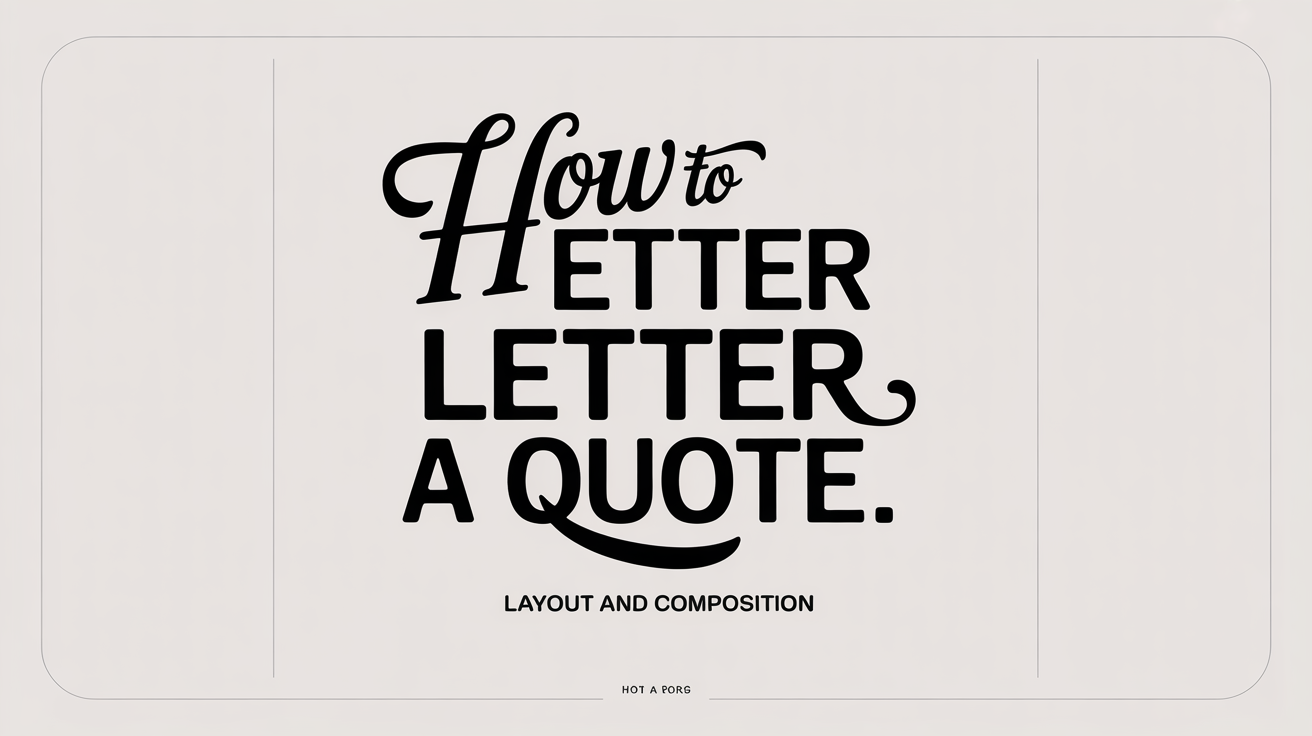
Lettering a quote feels exciting until you put pen to paper and realize you have no idea how big to write the first word. Half the letters disappear into the margin. The last line crowds the bottom. Sound familiar?
The good news is that composition, the arrangement of words and visual weight on the page, follows a small set of repeatable ideas. Once you understand them, every quote becomes a puzzle you know how to solve rather than a guessing game.
This guide walks you through the whole process from reading the quote to finishing the piece.
Read the Quote Like a Designer
Before you touch a pen or brush, sit with the text. Ask yourself three questions:
- What is the most important word or phrase? In "Not all those who wander are lost," the emotional punch lands on wander or lost. That word will become your focal word, the one you make largest or most decorative.
- Where are the natural line breaks? Read the quote aloud a few times. Notice where you pause. Those pauses usually become line breaks in the lettered piece.
- How many lines does this break into naturally? Quotes tend to land well at 3–5 lines. Fewer can feel sparse; more starts to look like a wall of text.
Write out a few possible line arrangements on a scratch sheet. Something like:
Option A:
Not all those
who wander
are lost

Option B:
Not all those who wander
are lost
Neither is wrong. Option A gives you three short lines of roughly equal length. Option B has one long anchor line and one short punchline beneath it. Both are valid compositions; the choice depends on the shape you want.
Plan Your Layout Before You Letter
A layout is the overall shape your words will make on the page. Most beginner quotes fit into a handful of reliable shapes.
| Shape | Description | Good for |
|---|---|---|
| Centered block | All lines centered on a vertical axis | Balanced, formal quotes |
| Flag (left-aligned) | Lines start at the left edge | Casual, modern hand lettering |
| Arch | Lines curve in a gentle arc | Single-line quotes or short mottos |
| Diamond | Short–long–short line progression | 3-line quotes with a dominant middle |
| Random/eclectic | Mixed sizes, angles, and styles | Modern brush lettering, Instagram style |
For your first few projects, centered block or diamond layouts are the easiest to execute neatly because the symmetry hides small sizing inconsistencies.
Sketch a Thumbnail First
A thumbnail sketch is a tiny, rough version of your layout, usually no bigger than a playing card. You are not lettering here. You are drawing rough rectangles to represent each line of text. This takes about two minutes and saves a lot of frustration.
Draw a small rectangle for your paper. Inside it, stack horizontal bars that represent each line of words, making bars wider or narrower to suggest relative word lengths. Then decide:
- Does the composition feel balanced?
- Is the focal word obviously larger?
- Does the layout feel centered on the page, or is it slipping to one side?
Adjust your thumbnail until it feels right, then use it as a guide when you move to full size.
Size Your Words to Create Hierarchy
Hierarchy (pronounced hi-er-ar-kee) means that some words look more important than others because of their size, weight, or style. Without hierarchy, every line competes for attention and the eye has nowhere to rest.
A simple three-level hierarchy works for most quotes:
- Primary (largest): The focal word or phrase. Often written in a script or brush style with more flourish.
- Secondary (medium): The rest of the main quote. Still readable and attractive, but quieter.
- Tertiary (smallest): Attribution, source, or filler words like "the" or "a" that can shrink without losing meaning.
You do not need to measure every letter precisely. A rough ratio of 3:2:1 for large, medium, and small text gives you a starting point. If your focal word fills about three inches tall, medium text might sit around two inches and small text around one inch.
Sizing Filler Words
Short connecting words, "the," "of," "and," "a," frequently appear in quotes and can clutter the layout if they get the same weight as content words. Many letterers shrink these words, tuck them between larger lines, or write them in a plain print style rather than a decorative one. This is called suppressing filler words, and it keeps the focal word central without your eye tripping over small connectors.
Transfer Your Layout to the Final Paper
Once you are happy with your thumbnail, you need to scale it up to your actual paper. Here is a reliable process:
- Mark your paper midpoint. Fold the paper lightly in half vertically to find the center line, or use a pencil tick mark at the top and bottom.
- Draw light guidelines. Use a pencil and ruler to mark baseline lines (the line your letters sit on) and cap-height lines (the top of your tall letters) for each row of text. Keep these lines very light; they will erase later.
- Write each word in pencil first. Sketch your lettering loosely in pencil at full size before committing with ink. You will catch sizing problems now rather than halfway through inking.
- Check the spacing between lines. The gap between lines is called leading (rhymes with "bedding"). Even leading throughout a piece looks clean. If one gap is noticeably bigger, your eye will snag on it.
- Ink over your pencil sketch. Let the ink dry completely before erasing the pencil lines. Rushing this step smears ink.
- Erase gently. Use a soft eraser and move in one direction to avoid lifting fibers from the paper surface.
If you want to add flourishes, small decorative strokes on ascenders (tall letters like b, d, h) or descenders (letters that dip below the baseline like g, y, p), sketch those in pencil too before inking. For a deeper look at what flourishing can do for a finished piece, an introduction to flourishing in calligraphy covers the basic stroke vocabulary.
Choose Styles That Work Together
Mixing lettering styles adds visual interest, but mixing too many creates chaos. A common beginner rule: two styles maximum per piece.
The classic combination is a flowing script for the focal word or phrase, paired with simple block print or sans-serif capitals for supporting lines. The contrast between curved and angular is easy to read and pleasing to look at.
A few style pairings that tend to work well for beginners:
- Brush script + print caps
- Italic calligraphy + small caps
- Monoline print + one flourished word in script
Notice what these pairings have in common: one style is decorated, one is plain. When both styles compete equally, the layout feels restless. Give one style the leading role.
Add Decorative Elements Sparingly
Flourishes, small illustrations, borders, and dividers all have a place in quote lettering. The risk for beginners is adding decoration to fill empty space rather than using it intentionally.
Before adding a decorative element, ask: does this lead the eye toward the focal word, or does it pull attention away from it? A small botanical sprig under a nature quote, positioned below the text rather than beside it, frames the piece without competing. A large border that crowds the text on all four sides usually hurts more than it helps.
Simple dividers, a single thin line, three dots, a small leaf, between lines of mixed styles can help separate visual levels and make the hierarchy clearer. Keep them small and quiet.
Once you are comfortable with plain quote compositions, you might want to explore how those same skills carry over into more personal projects like hand-lettered greeting cards for beginners.
Practice Layout as a Separate Skill
Most lettering practice focuses on individual letters and strokes. Layout practice works differently. Take a quote you know well and letter it five different ways in your sketchbook: centered, left-aligned, with a large focal word, with a small focal word, with and without filler words shrunk. This forces you to see how the same words can carry entirely different moods depending on arrangement.
Lettering addresses and envelopes is another good layout exercise because each line is a different length, which mimics the challenge of quoting without the pressure of a final piece. How to address envelopes in calligraphy walks through that process step by step.
Your early attempts at quote layout will look uneven. The focal word might still be too close in size to the supporting text, or the spacing between lines might drift. That is normal and part of how the skill develops. Keep your practice sheets so you can look back after a dozen projects and see how your eye for proportion has sharpened.
Frequently Asked Questions
How do I decide where to break the lines in a quote?
Read the quote aloud several times and notice the natural pauses. Those usually align with grammatical breaks: end of a clause, end of a phrase, or just before a conjunction like "but" or "and." Try two or three different arrangements in your sketchbook and pick the one that gives you lines of roughly similar length or a shape that fits your layout goal.
My focal word looks too big compared to the rest. How do I fix it?
The most common fix is to shrink the secondary text rather than the focal word. Try dropping the medium text down one size and see if the ratio feels more natural. You can also check that the focal word is not sitting in the exact center of the page — slightly above center often looks more balanced because the eye expects a little extra breathing room at the bottom.
Do I need special paper for quote lettering projects?
Not for practice. Smooth printer paper works fine for pencil sketching and thumbnail planning. For inking, look for paper with low absorbency so the ink sits on the surface instead of bleeding into the fibers. HP Premium 32 lb paper is a common recommendation in lettering communities, but smooth bristol board and dedicated calligraphy pads also work well. Test your specific ink and pen combination on a scrap piece before starting the final piece.
Can I use a grid or dots to keep my lines straight?
Yes. Dot-grid notebooks and pre-printed calligraphy practice pads with baseline and waist-line guides are helpful, especially early on. For final pieces on blank paper, light pencil guidelines do the same job and erase cleanly afterward. Some letterers use a light box to trace guideline sheets through the paper, which leaves no erasing to worry about.
What should I do if I run out of space partway through the quote?
Stop, let the ink dry, and assess. If only one or two words are crowding the bottom, you can sometimes squeeze in smaller text or break at a different point. If the whole piece is off-scale, it is usually faster to start fresh with the corrected thumbnail than to try to rescue the current sheet. Keeping an extra sheet of the same paper at hand before you start is a habit worth building early.