Getting Started
Left-Handed Calligraphy: A Beginner's Guide
Yes, left handers can do calligraphy. Learn paper rotation, hand positions, pen holder choices, and how to avoid ink smudges from the start.
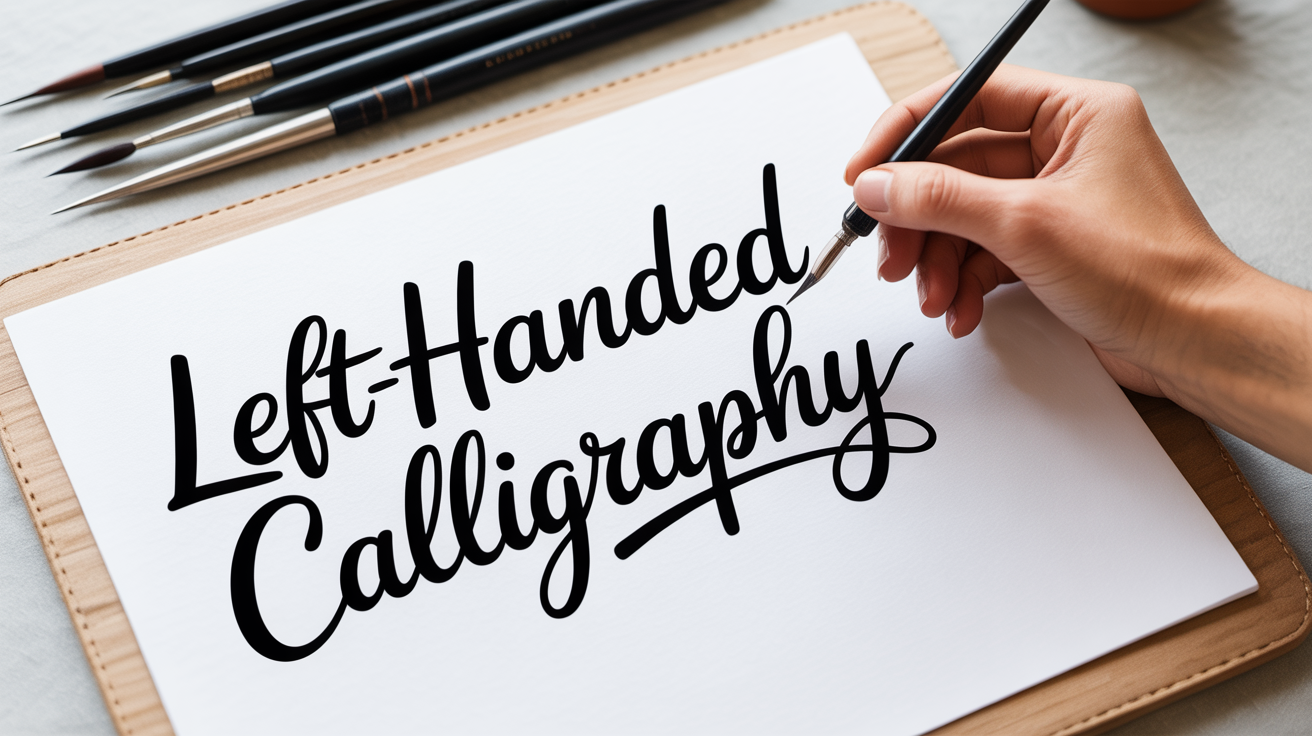
Left handers can absolutely do calligraphy. The craft was built around right-handed conventions, which means a few physical adjustments help, but none of them are difficult to learn. Millions of left-handed calligraphers work in Copperplate, italic, modern brush lettering, and every other style. The main skill is understanding how to position your paper and your hand so the nib (the metal writing tip that splits into two tines) moves in a direction it can handle without catching.
This guide explains those adjustments, covers pen choices that make the angle easier, and gives you a clear starting point regardless of what style you want to learn first.
Underwriter or Overwriter? Identify Your Hand Position First
Left handers fall into two groups, and the group you belong to changes which adjustments work best for you.
An underwriter holds the wrist below the baseline, curling the hand so it hooks under the writing. The pen points roughly upward and away from the body. This grip is actually the easier starting point for calligraphy because the hand moves away from wet ink after each stroke, which reduces smudging.
An overwriter (also called a hooked-wrist writer) hooks the wrist above the line, pointing the pen downward. The hand drags across what was just written. Overwriters see more smudging at first and often need to adjust paper angle more aggressively, but the style is absolutely workable with the right setup.
If you are not sure which you are, write a few lines of normal handwriting and watch where your wrist sits relative to the line you are on.
How to Rotate Your Paper
Paper angle is the single adjustment that makes the biggest difference for left-handed calligraphy.
Right-handed pointed-pen calligraphy typically places the paper at about 30 to 45 degrees clockwise from vertical, with the top of the page angled toward the right shoulder. Left handers generally do better rotating the paper counterclockwise instead, so the top of the page angles toward the left shoulder.
How far to rotate depends on your grip:
- Start with the paper straight (parallel to the desk edge) and write a few strokes.
- Rotate the page counterclockwise by 15 degrees and try again.
- Keep rotating in small increments until the thick downstroke feels like a natural pull rather than a push or drag.
Underwriters often land somewhere between 30 and 60 degrees counterclockwise. Overwriters sometimes go as far as 90 degrees, placing the page nearly horizontal, because that angle lets the pen travel in a more natural direction for the hook grip.
There is no single correct number. Use whatever angle lets you draw smooth, connected strokes without fighting your wrist.
Choosing Between a Straight Holder and an Oblique Holder
A straight holder is exactly what it sounds like: a barrel with no angle offset. The nib sits in line with the barrel.
An oblique holder has a flange (a small metal or plastic bracket) that angles the nib out to the side. It was designed to help right-handed writers achieve the steep slant used in classic Copperplate script without twisting the wrist. For most right handers it is the standard choice.
For left handers, the oblique holder designed for right-handed use can work against you, pushing the nib further out of alignment. There are two options:
- Use a straight holder. Many left handers find a straight holder with the paper rotated properly gives all the angle they need. This is the simpler starting point.
- Use a left-handed oblique holder. These have the flange on the opposite side, which mirrors the right-handed oblique and can help overwriters achieve a cleaner angle without extreme paper rotation. They are less common but available from specialty nib retailers.
If you are just getting started, try a straight holder first. It removes one variable while you are still learning how paper angle and hand position interact.
Dealing With Smudging
Smudging is one of the most common frustrations in left-handed lettering, and it is mostly a solved problem once you understand the cause. Calligraphy ink stays wet on the page for longer than ballpoint or gel ink, and left handers often drag the side of the hand across letters they have already written.
Practical ways to reduce smudging:
- Write from top to bottom, left to right within each word, but move to the right column before the left column finishes drying when writing in lines. The goal is to keep your hand away from wet ink.
- Use a small piece of paper or card under your writing hand to lift it slightly above the page surface.
- Choose a faster-drying ink. Iron gall inks tend to dry faster than some carbon-based inks. Avoid inks described as "extra glossy" or "slow drying."
- Work on a non-absorbent paper. Paradoxically, very smooth paper dries some inks more slowly. Slightly textured practice paper can wick ink faster.
- Write smaller for practice. Smaller letters mean the hand is closer to dry areas by the time it passes over earlier strokes.
Smudging is normal at first. Give yourself a few sessions to find the combination of paper rotation, grip, and ink that works for your hand.
Building Basic Strokes as a Left Hander
The thin upstroke and thick downstroke that define pointed-pen calligraphy come from pen pressure, not hand speed. On the upstroke, you press lightly so the two tines of the nib stay together and produce a fine line. On the downstroke, you press more firmly so the tines spread and lay down a thick line.
Left handers achieve this exactly the same way as right handers. The adjustment is not in the pressure itself but in the direction of travel. Once your paper is at the right angle, a downstroke should feel like pulling the pen toward your body or toward the lower left. If it feels like pushing, rotate the paper a little further.
Practice the basic strokes before attempting letters:
- Draw a series of thin upstrokes from bottom to top, keeping pressure light.
- Draw a series of thick downstrokes from top to bottom, pressing firmly.
- Combine them into an oval: thin upstroke on the left side, thick downstroke on the right.
- Practice the undercurve (the curved upstroke that starts most lowercase letters in Copperplate).
If you want context on how these strokes connect to a full alphabet, the guide on how to hold a calligraphy pen: grip and posture covers the body mechanics that apply to both hands.
Starting With Brush Pens Instead of Dip Pens
Left handers sometimes find brush pens a more forgiving first tool than a pointed dip pen. A brush pen has a flexible fiber tip rather than a metal nib, so there are no tines to catch on the paper and no risk of ink pooling from an incorrect angle.
The principles of thick downstrokes and thin upstrokes carry over directly from brush pens to pointed pens, so the skills transfer. If you want to build confidence before committing to a nib setup, starting with brush pens is a reasonable path.
If you are not ready for either and want to practice the visual logic of calligraphy first, faux calligraphy: how to fake it with any pen is a useful first step. You draw normal letters, then add thickened downstrokes by hand, which builds the eye for contrast before the hand is trained.
Once you know what style direction you want, the comparison in calligraphy vs. hand lettering: what's the difference can help you choose which learning path fits your goals.
Frequently Asked Questions
Can left handers do calligraphy as well as right handers?
Yes. Hand dominance does not limit the quality of calligraphy you can produce. The scripts themselves are not easier or harder for either hand; the difference is only in which physical setup works best. With the right paper angle and pen choice, left-handed calligraphy is indistinguishable from right-handed work.
Do I need a special pen for left-handed calligraphy?
Not necessarily. Many left handers work comfortably with a standard straight holder and any pointed nib. A left-handed oblique holder exists and helps some overwriters, but it is not required. Starting with a straight holder keeps things simple.
Why does my nib keep catching on the paper?
Nib catching usually means the pen is pushing into the paper at an angle instead of gliding. The most common cause for left handers is paper rotation that has not gone far enough. Try rotating the page another 10 to 15 degrees counterclockwise and test again. A new or damaged nib can also catch; make sure your nib is not bent and has been lightly cleaned of factory oils before first use.
Is smudging permanent if I am left-handed?
No. Most left handers find smudging decreases quickly as they develop habits around paper positioning and hand placement. Switching to a faster-drying ink and keeping a barrier sheet under the writing hand resolves it for most people within the first few practice sessions.
Which calligraphy style is easiest for left handers to start with?
Modern brush lettering and italic are both cited by left-handed calligraphers as approachable starting points because the letterforms are more upright and the strokes are shorter. Classic Copperplate has a steep right-leaning slant that can feel awkward at first for overwriters specifically. There is no rule, though; use whichever style you find most motivating and let your setup adjust around it.