Tools & Supplies
The Best Brush Pens for Beginners
How to choose beginner brush pens for hand lettering: tip types, firmness, ink, and what to look for before you buy.
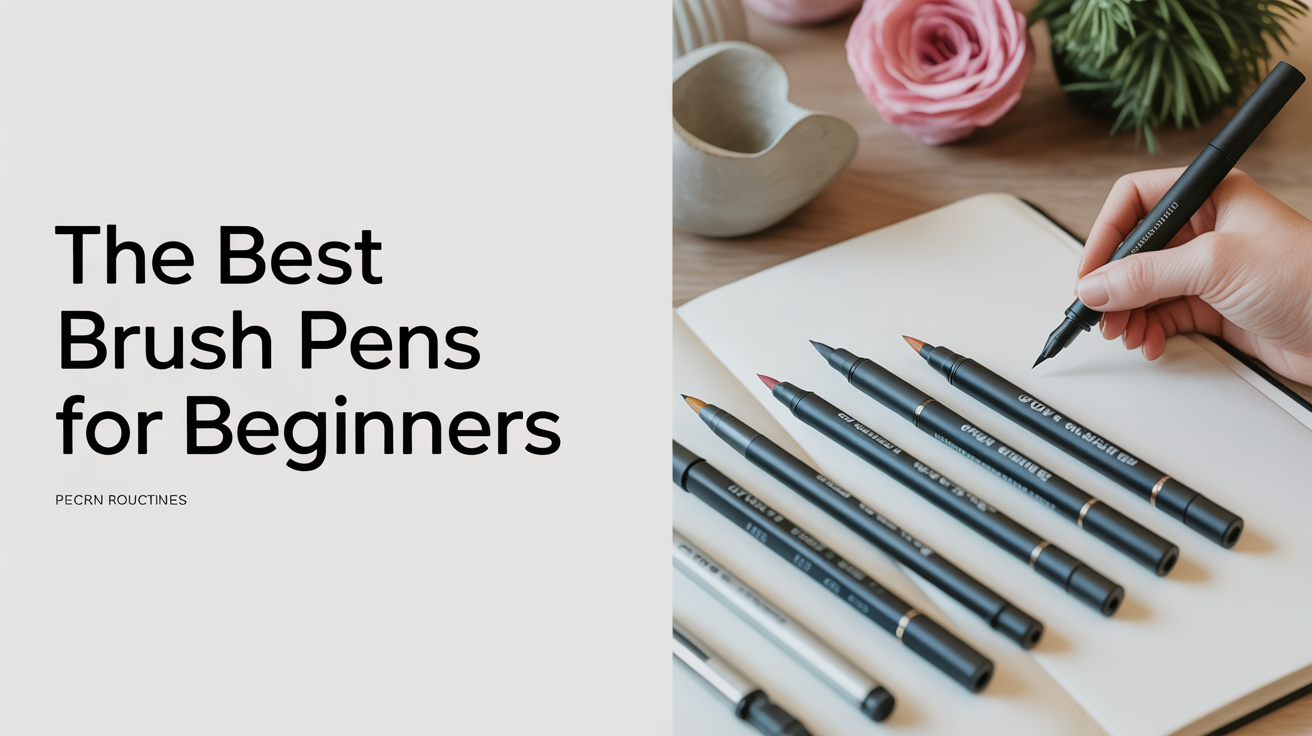
If you've watched someone letter with a brush pen and thought, "I want to do that," you're in the right place. Picking your first brush pen is genuinely confusing because the options are endless and the packaging rarely tells you what actually matters for a beginner. This guide cuts through that.
The short answer: start with a small-tip brush pen that has a firm tip. It gives you more control while your hand is still learning the pressure-and-angle relationship that makes brush lettering work. Everything else, ink choice, brand, paper, follows from there.
What a Brush Pen Actually Is (and How It Differs from a Regular Marker)
A brush pen is a marker-style pen with a tip designed to flex. That flex is the whole point. When you press lightly and pull the pen toward you, the tip narrows and produces a thin line. When you press harder on a downstroke (a stroke moving toward you on the page), the tip spreads and produces a thick line. The contrast between those thicks and thins is what gives brush lettering its distinctive look.
A standard marker or felt-tip pen doesn't do this. The tip is rigid, so the line width stays uniform regardless of pressure. That's fine for printing; it doesn't produce the thick-thin variation that defines brush lettering.
The tip of a brush pen is typically made from one of three materials:
- Bristle/synthetic brush tip: Made from individual fibers, similar to a small paintbrush. Very responsive to pressure, behaves almost like a real brush. More forgiving of technique variation, but harder to control at first.
- Felt tip (tapered): A single piece of dense felt shaped to a point. Firmer than bristle, less springy. Easier to control early on because it doesn't wobble as much.
- Nylon/hard nylon tip: Stiff, durable, and consistent. Great for beginners who want predictability.
The One Quality That Matters Most: Tip Firmness
New letterers consistently struggle more with soft-tipped brush pens than firm ones, even though soft tips look impressive in videos. Here's why.
A soft tip is very sensitive. The slightest change in pressure or angle affects the line. Until your hand has built up some muscle memory for the pressure-angle relationship, a soft tip magnifies every wobble and hesitation. You end up fighting the pen instead of learning the letterforms.
A firm tip has less sensitivity. It requires more deliberate pressure to spread, so accidental wobbles matter less. You can focus on the actual shapes of the letters rather than constantly managing the tip.
As a rule of thumb:
- Firm tips: Better for beginners. More control, less drama.
- Soft tips: Better once you've got some practice under your belt. More expressive, but less forgiving.
Small Tip vs. Large Tip: Which Should You Start With?
Brush pens come in different tip sizes, often labeled as small (or fine), medium, and large (or jumbo). The size affects how big your letters will naturally be.
Large-tip pens want large letters. Writing small with a large tip is awkward and makes it hard to form clean letterforms. Conversely, a small-tip pen lets you work at a manageable scale on a standard notebook page.
For most beginners, a small-tip pen in the 2-5mm range is the practical starting point. You can practice on regular paper, fill a standard-sized page with useful repetitions, and see your letter shapes clearly without needing a huge workspace.
Once you're comfortable with the fundamentals, adding a large-tip pen is worth it. Large tips work beautifully for loose, expressive lettering and for pieces where scale is part of the impact. But starting large tends to lead to frustration because the tip overwhelms the paper before your technique is ready.
For more on how to build out a complete beginner setup, see our guide to what you actually need in a calligraphy starter kit.
Ink Type: Water-Based vs. Pigment-Based
Most brush pens use one of two ink formulations:
Water-based dye inks are common in entry-level pens. They're smooth, blend easily with water or with each other, and are usually lightfast enough for practice. The downside is that they can bleed on thin paper.
Pigment-based inks are more archival (they resist fading) and often more vibrant. They're also thicker, which means they can dry in the tip if you're not careful, especially in a pen that sees irregular use. Keep the cap on.
For practice sessions, water-based inks are perfectly fine. If you're making a piece you want to keep or photograph, pigment-based inks tend to produce richer, more consistent results.
A practical comparison:
| Feature | Water-Based Dye | Pigment-Based |
|---|---|---|
| Blending | Easy | Harder |
| Paper bleed | More likely on thin paper | Less bleed on quality paper |
| Archival quality | Lower | Higher |
| Tip clogging risk | Low | Higher if tip dries |
| Best for | Practice, blending exercises | Finished pieces |
Paper Makes a Bigger Difference Than Most Beginners Expect
You can have a great pen and still get ragged, feathery lines if your paper is wrong. Brush pens need smooth paper. Regular copy paper (20 lb office paper) is too porous, and the ink bleeds into the fibers, making crisp lines impossible.
Look for:
- Marker paper or layout paper: Smooth, slightly translucent, designed for markers. Handles multiple passes without bleeding.
- Hot-press watercolor paper: Smooth surface, handles water-based inks well. Heavier and more suitable for finished pieces.
- Smooth Bristol board: Excellent surface for both practice and presentation work.
A cheap pad of smooth marker paper is one of the best investments you can make early on. The pens you already have will perform noticeably better on it.
How to Practice: Getting Your First Strokes Down
Before you letter a single word, spend some time with basic strokes. This is not busywork. It's how you train your hand to apply consistent pressure and maintain a consistent angle. Think of it as scales before learning a song.
-
Set your pen angle. Hold the pen at roughly 45 degrees to the page. This is not a rigid rule, but it's a reliable starting point. Too flat and you're pushing the tip awkwardly; too steep and you lose the line variation.
-
Practice the downstroke. Pull the pen toward you with light-to-medium pressure. You're aiming for a thick line. Do a row of parallel downstrokes without lifting the pen between them. Keep them even.
-
Practice the upstroke. Push the pen away from you with very light pressure. You want a thin line. This is harder than it sounds, because pushing a brush tip can cause it to flop sideways if you apply too much pressure. Go slowly.
-
Combine them into ovals. Draw connected oval shapes that naturally alternate downstrokes (thick) and upstrokes (thin). These ovals are the building blocks of most brush lettered lowercase letters.
-
Try the bounce. Once the oval feels natural, add a small bounce at the baseline: let the oval dip slightly below the line before returning. This gives brush lettering its characteristic lively quality.
Your first attempts will look shaky. That's expected and completely normal. Shaky strokes don't mean you're doing it wrong; they mean your hand hasn't built the muscle memory yet. Consistency comes with repetition, not with trying harder in any single session.
If you want to understand how different nib styles and tools produce different line qualities, our calligraphy nibs guide explains the mechanics in plain terms.
A Simple Brush Pen Starter Checklist
Before buying, run through this:
- Tip type: firm felt or nylon for maximum control
- Tip size: small (2-5mm range) for working at manageable scale
- Ink type: water-based for easy practice and blending
- Paper: smooth marker or layout paper (not copy paper)
- Quantity: 2-3 pens in different colors to start, not a full set
Buying a large set of 20 pens before you know what you like is a common beginner mistake. Start small, find out which tip style clicks for you, then expand.
Frequently Asked Questions
Do I need to buy expensive brush pens as a beginner?
No. Some of the most recommended beginner pens cost under two dollars each. Price often reflects ink volume, brand reputation, or tip longevity rather than beginner-friendliness. A mid-range pen in the $3-8 range from an art supply or stationery shop is a reasonable starting point. Spend money on good paper before you spend it on premium pens.
Can I use brush pens for traditional calligraphy styles like Copperplate or Spencerian?
Brush pens produce brush lettering, which is related to but distinct from traditional pen-and-ink calligraphy styles. Copperplate and Spencerian scripts use a pointed nib dipped in ink, which creates a different line quality and requires a different technique. If you're drawn to those styles, you'll eventually want to explore pen holders and pointed nibs. Brush pens are great for modern brush lettering and can be a low-barrier way to start before committing to dip pen supplies.
Why does my brush pen tip splay and go flat?
Tip splaying usually means you're applying too much pressure, especially on upstrokes. The brush tip is designed to spread under pressure on downstrokes, but upstrokes should be light. If you're pressing hard throughout, the tip gradually bends out of shape. Some splaying is normal with heavy use, but if it happens within the first few sessions, try using noticeably lighter pressure on strokes that travel upward or sideways.
Should I cap my brush pen between strokes?
You don't need to cap the pen between individual strokes during a session. But always cap it when you set it down for more than a minute or two, and always cap it at the end of a session. Water-based inks are relatively forgiving if a tip dries slightly, but pigment-based inks can permanently dry in the tip if left uncapped. Store pens horizontally or tip-down, not tip-up.
How long should a brush pen last?
It depends on how often you use it and on what paper. Rough or textured paper degrades tips faster than smooth marker paper. A pen used daily for focused practice might last a few weeks to a couple of months. If you notice lines becoming scratchy, inconsistent, or the tip no longer returning to its point, it's time to replace it. Some brands sell replacement tips for their pens, which is a more economical option once you know which pen you prefer.