Brush Lettering
The Basic Strokes of Brush Lettering
Master brush lettering basic strokes with this beginner guide. Learn the 8 core strokes, how to hold your pen, and drills to build muscle memory.
Every letter in brush lettering is built from a small set of repeating shapes. Before you try to write a word, it helps to know that you're really just combining eight or so strokes over and over. Once your hand learns those strokes, whole letters and eventually whole words start to follow. That's the promise of practicing basic strokes, and it's why most experienced letterers still warm up with drills.
This guide walks through each of the core brush lettering strokes, how to practice them, and what to watch for when things feel off.
What Are Basic Strokes (and Why They Matter)?
In brush lettering, a stroke is a single continuous movement of the pen from one point to another. Every letter in the alphabet can be broken down into a handful of these strokes. Think of them as the alphabet's own alphabet.
Working on strokes in isolation is useful because your hand can focus on one thing: pressure and direction. When you try to write a full letter right away, your brain is managing the stroke shape AND the letter recognition at the same time. Separating those tasks makes both easier.
There are eight strokes you'll use constantly:
| Stroke Name | Motion | Used In |
|---|---|---|
| Downstroke | Top to bottom, heavy pressure | Every letter |
| Upstroke | Bottom to top, light pressure | Most letters |
| Overturn | Arch curving down | n, m, h, r |
| Underturn | Arch curving up | u, i, j, l |
| Oval | Closed or nearly-closed curve | o, a, d, g, q |
| Compound curve | S-shaped combination | s, z |
| Ascending loop | Tall upward loop | b, h, k, l |
| Descending loop | Downward loop | g, j, p, y |
You don't need to memorize this table. The point is that a lower-case "n" really is just an overturn. Once you feel comfortable with overturns, the "n" comes naturally.
Tools to Start With
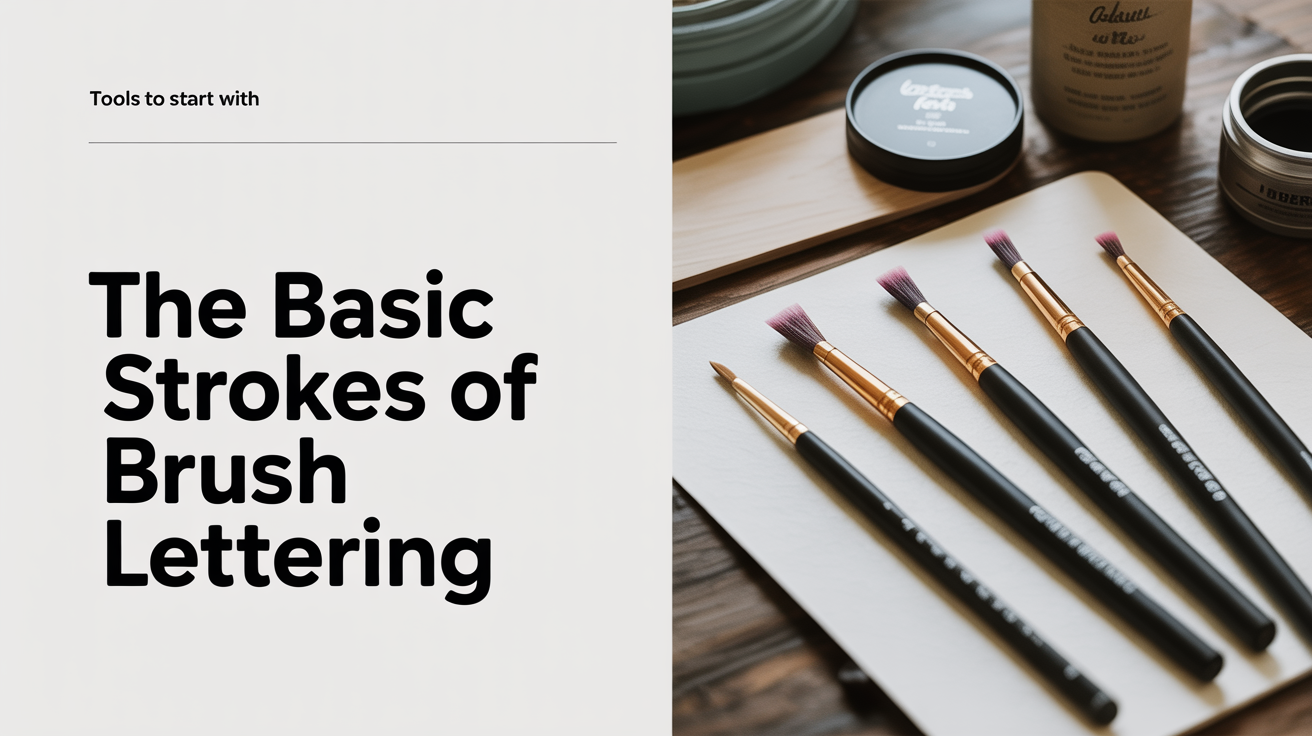
You don't need expensive supplies for stroke practice. That said, the tool in your hand does affect how the strokes behave.
Brush pens: For beginners, a medium-tip brush pen with a firm or semi-firm tip is the most forgiving. A very soft or very large tip requires more controlled pressure to keep thin upstrokes from spreading too wide. Choosing the right size pen for your lettering style covers the tradeoffs in more detail, but for pure stroke practice, a small or medium tip with moderate flexibility is a solid starting point.
Paper: Smooth paper matters more than most beginners expect. Textured paper catches the brush tip on upstrokes and splits hairs you didn't mean to split. Marker paper, layout paper, or a smooth cardstock works well. If you only have standard printer paper, that's fine to start, but don't worry if upstrokes feel scratchy on it.
Guidelines: Print or draw horizontal lines spaced about 5-7mm apart for small tips, or wider for larger pens. Practicing without guidelines is harder to evaluate because you can't tell if your angles are consistent.
The Most Important Concept: Pressure Control
Brush lettering is based on a simple rule. Heavy pressure on the way down; light pressure on the way up. That difference in pressure is what makes brush lettering look the way it does.
When you press down on a brush pen, the tip flexes and spreads, creating a thick line. When you lift pressure and glide upward, the tip narrows to a point, creating a thin line. The contrast between thick and thin is the defining visual quality of the style.
How to practice pressure alone:
- Hold your pen at roughly a 45-degree angle to the paper. Steeper or shallower both work, but 45 degrees is a common starting point.
- Press the tip firmly against the paper and drag it straight downward. You should see a wide, opaque line.
- Lift most of the pressure off and drag the tip straight upward. You should see a narrow, faint line.
- Repeat ten times, alternating down and up, without lifting the pen off the page.
Those alternating lines are your first stroke drill. They're called full-pressure downstrokes and hairline upstrokes, and warming up with them for two or three minutes before any practice session trains the pressure instinct.
The Eight Core Strokes, One at a Time
Downstroke and Upstroke
Start every session here. The downstroke is a straight diagonal line from upper-left to lower-right with full, even pressure throughout. The upstroke is the reverse: a thin diagonal from lower-left to upper-right with almost no pressure.
Practice them in pairs. Draw a downstroke, then connect directly into an upstroke at the bottom. That connected V-shape is the foundation of many letters.
Overturn
An overturn is an upside-down arch. It begins with a thin upstroke, curves over the top, and comes back down as a thick downstroke. The thin-to-thick transition at the peak of the arch is where beginners often lose control.
Go slowly over the arch. Let the pressure build gradually as you come down the right side. If your thick side is lumpy, it usually means you applied all the pressure at once instead of easing in.
Letters that use overturns: n, m, h, r.
Underturn
The underturn is the mirror of the overturn. It starts with a thick downstroke, curves at the bottom, and rises into a thin upstroke. The tricky transition here is at the bottom of the curve, where you need to release pressure quickly to thin the line before it rises.
Letters that use underturns: u, i, j, l.
A quick check: if your underturns look the same coming down as going up (same thickness), you're not releasing pressure at the curve. Slow down at the bottom.
Oval
The oval is a rounded shape, either closed or open on the right side. For letters like "o," it's fully closed. For letters like "a," "d," "g," and "q," the right side stays open so additional strokes can attach.
The thick part of an oval falls on the left side (roughly between 7 and 11 o'clock if you imagine the oval as a clock face). The thin part is at the top and bottom. Many beginners make the oval too circular or put the thick part at the bottom by accident. Slow rotation and deliberate pressure placement help.
Compound Curve
The compound curve is an S-shaped stroke. It moves from a thin upstroke that transitions into a thick downstroke, then back into a thin upstroke at the bottom. You're essentially stacking an overturn and an underturn.
This stroke appears in "s" and "z." It requires two pressure transitions in one continuous motion, so it tends to take more practice than the others. Don't rush it.
Ascending and Descending Loops
Ascending loops are tall upstrokes that loop back down, used for the tall parts of "b," "h," "k," and "l." Descending loops drop below the baseline and curve back up, appearing in "g," "j," "p," and "y."
For both, the loop portion is thin (low pressure) and the downstroke that follows or precedes it is thick. A common issue is making loops too small and cramped. Give them room.
How to Structure a Practice Session
Consistency beats duration. Twenty focused minutes several times a week builds more muscle memory than a two-hour session once in a while.
A straightforward session structure:
- Warm up (3-5 min): Fill a page with alternating downstrokes and upstrokes. No letters, just lines.
- Stroke drills (10-15 min): Work through each stroke type in order. Fill a few rows with each before moving on.
- Letter attempts (5 min): Pick one or two letters and try connecting the strokes you've drilled into actual letterforms.
- Review (2 min): Look back at your practice. Pick one thing that improved and one thing to focus on next time.
You don't need to get through all eight strokes in every session. Picking two or three to focus on deeply is often more effective than a shallow run through all of them.
If you want to move beyond individual letters into color work later on, blending colors with brush pens for ombre lettering is a natural next step once stroke control is solid.
Common Problems and What's Causing Them
Upstrokes are thick instead of thin. You're not releasing enough pressure on the upward motion. Think of barely resting the tip on the paper, as if the pen is almost floating.
Downstrokes are wobbly. This is normal early on and gets smoother with repetition. It also helps to slow down and use your whole arm for longer strokes rather than only your fingers.
The thin-to-thick transition looks abrupt. Ease into pressure rather than pressing all at once. Imagine dimming a light rather than flipping a switch.
The brush tip is splitting or splaying on upstrokes. The paper may be too textured, or you may still be applying pressure during the upstroke. Switching to smoother paper often clears this up immediately.
Nothing looks like calligraphy yet. This is the most common frustration for beginners, and it almost always resolves with time. Strokes that look clumsy in week one often look clean by week four. The goal right now is to train your hand, not to produce display-quality work. If you want a broader orientation to the craft, brush lettering for beginners: a complete guide covers the full picture.
Frequently Asked Questions
How long does it take to learn the basic strokes?
Most beginners start to feel real control over downstrokes and upstrokes within a few weeks of regular practice. Full comfort with all eight strokes, including loops and compound curves, usually takes one to three months of practicing several times a week. Shaky early progress is completely normal and says nothing about your eventual ability.
Do I have to practice strokes before learning the alphabet?
You don't have to, but most people find it easier. Trying to write letters without stroke fundamentals often leads to bad habits that are harder to unlearn than to avoid. Even a week of focused stroke drills before attempting letters tends to make letter-learning faster.
What angle should I hold the brush pen?
A 45-degree angle from the paper is a common starting point, but anywhere from 30 to 60 degrees can work depending on the pen and the stroke. Steeper angles (closer to 90 degrees) reduce the range of pressure flex in most pens. Experiment and find what gives you the most consistent thick-thin contrast.
My pen isn't making thick lines no matter how hard I press. What's wrong?
First, check that the tip is facing the right way: the flat or angled side of the tip should be against the paper, not the narrow edge. If that's correct, the pen may need priming. New pens sometimes need a few strokes on scrap paper to get ink flowing to the tip. Pressing too hard can also permanently splay the tip on softer pens, so if the tip looks bent outward, that pen may have reached the end of its life.
Can I practice strokes digitally on a tablet?
Yes. A tablet with a pressure-sensitive stylus replicates the thick-thin dynamic reasonably well, and smooth screen surfaces make upstrokes easier than textured paper. The feel is different from a real brush pen, but the muscle memory for pressure control transfers. Many letterers use digital tools for drills and paper for final pieces.