Pointed Pen
Thin Upstrokes and Thick Downstrokes Explained
Learn why pointed pen calligraphy uses thin upstrokes and thick downstrokes, how pressure controls line weight, and drills to build consistent strokes.

The single rule that defines pointed pen calligraphy: apply light pressure on the way up, heavier pressure on the way down. Those two contrasting strokes, thin hairlines going up, broad swells coming down, are what make traditional scripts like Copperplate and Spencerian look so graceful. Once you understand the mechanics behind them, everything else in pointed pen starts to make sense.
Why the Direction of Your Stroke Changes the Line
A pointed pen nib (the small metal tip you dip into ink) has two thin metal prongs called tines. At rest, the tines press together, producing a fine point. When you push downward on the paper with enough force, the tines spread apart, allowing more ink to flow onto the surface. Release that pressure, and the tines close again.
This flex behavior is at the heart of pointed pen. The nib is a simple spring: squeeze it and the line widens; ease off and it narrows. Direction matters because of the mechanics of the hand. Pulling a stroke toward your body (a downstroke) lets you bear down with controlled, even pressure. Pushing a stroke away from your body or sideways (an upstroke) risks catching the nib on the paper fibers, which would cause it to snag or spray ink. Keeping upstrokes light prevents that snagging and produces the clean, fine hairlines that contrast so beautifully with the thick downstrokes.
So the rule is not arbitrary. It comes directly from how the tool works and how the hand moves most comfortably.
Getting to Know Your Tools Before You Start
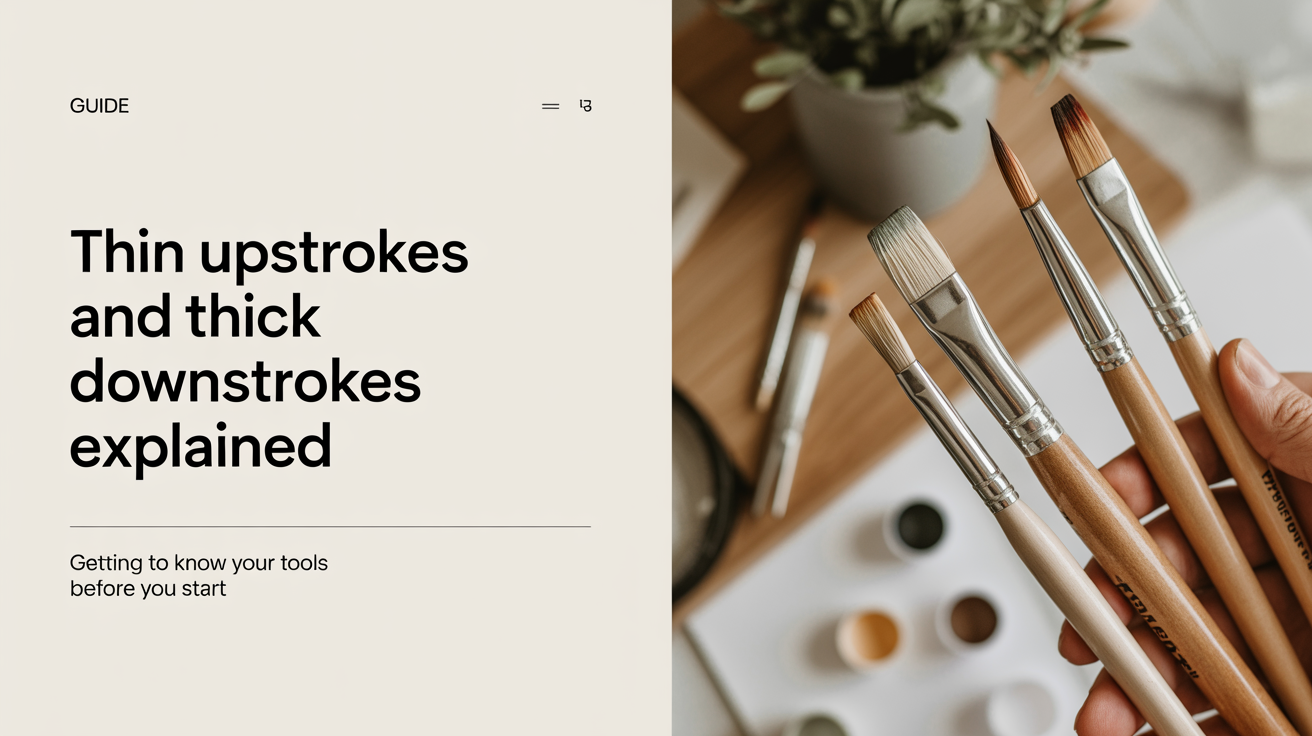
You do not need an expensive setup to learn these strokes. A few things to have in place before you practice:
| Supply | What to Look For |
|---|---|
| Nib | A beginner-friendly flexible nib with moderate spring tension |
| Holder | Oblique holder for slanted scripts; straight holder also works |
| Ink | Black non-waterproof calligraphy ink, free-flowing consistency |
| Paper | Smooth, coated paper with low tooth; printer paper is too rough |
If you are new to assembling your pen, see our guide on how to assemble a dip pen and insert a nib before moving further.
Choose a nib labeled as "flexible" or "soft" rather than a stiff mapping nib. A very stiff nib will not spread its tines no matter how much pressure you apply, making it impossible to produce thick strokes. On the opposite extreme, a super-flexible nib is very hard to control when you are starting out. Something in the middle, with moderate give, lets you feel the feedback without fighting it.
Load ink correctly, too, overloaded nibs blob; underloaded nibs skip. The guide on how to load ink onto a calligraphy nib covers exactly how much to pick up.
How Much Pressure to Apply
This is where most beginners get stuck. "Light" and "heavy" are vague words, so here are more concrete starting points.
For upstrokes (hairlines): Imagine you are drawing a line on a sheet of tissue paper without tearing it. Your pen should barely graze the surface. If your upstroke looks the same width as your downstroke, you are pressing too hard. If your upstroke skips or catches, your nib may have a small burr, or your paper is too textured.
For downstrokes (thick strokes): Start with just enough pressure to feel the tines separate slightly. On most beginner-friendly nibs, that is less force than you think. You should see the line widen, but you do not need to press until the nib bends dramatically. Extreme pressure leads to ink flooding and nib damage.
A useful mental image: think of the downstroke as leaning into the pen rather than stabbing at the paper. Your whole arm contributes, not just your fingers. For a detailed breakdown of pressure mechanics, our article on how much pressure to use in pointed pen calligraphy goes deeper into the topic.
Practicing Upstrokes and Downstrokes in Isolation
Before you write a single letter, it helps to practice the individual strokes in isolation. These drills are sometimes called oval drills and shade drills, but you can start even simpler.
The Basic Upstroke Drill
- Hold the pen at roughly a 45-degree angle to the paper, pointed toward your dominant shoulder.
- Place the nib near the bottom of your practice area.
- Using almost no pressure, draw a thin diagonal line upward and to the right. This is your hairline upstroke.
- Lift the pen. Reset at the bottom.
- Repeat in a column, spacing the lines about a finger-width apart.
Aim for lines that look like fine pencil marks. Shaky strokes at first are completely normal. The hand is learning a new motion, and consistency takes time.
The Basic Downstroke Drill
- Place the nib at the top of your practice area.
- Apply moderate pressure so the tines spread just a little.
- Pull the stroke downward toward you in a straight or slightly diagonal line.
- Maintain even pressure for the full length of the stroke, then ease off at the bottom.
- Lift and reset.
At first, your downstrokes will likely vary in width from top to bottom. That is because pressure is easier to apply at the start of a stroke than to sustain. Practice sustaining it through the whole movement.
Combining Them: The Entry Stroke Drill
Once you have each stroke independently, combine them:
- Start with an upstroke from the baseline (the imaginary line that letters sit on) to the x-height (the height of a lowercase letter without ascenders).
- At the top of the upstroke, release pressure completely.
- Without lifting the pen, transition into a downstroke, applying pressure as you pull back down.
This upstroke-into-downstroke pattern appears in almost every letter in Copperplate script, so this drill is genuinely foundational.
Common Problems and How to Fix Them
| Problem | Likely Cause | Fix |
|---|---|---|
| Upstrokes catch and spray ink | Nib snagging on paper texture | Switch to smoother paper; check nib for burrs |
| Downstrokes look the same width as upstrokes | Not enough flex in nib, or insufficient pressure | Try a more flexible nib; increase downstroke pressure slightly |
| Ink floods or blobs on downstrokes | Too much pressure or over-inked nib | Reduce pressure; wipe excess ink from nib before writing |
| Shaky or uneven lines | Grip tension or wrist-only movement | Relax the hand; use the whole arm to move across the page |
| Ink skips on upstrokes | Nib is dry or paper is too rough | Re-dip sooner; try a different paper |
Most of these problems are tool or surface issues, not failures of skill. If your strokes look inconsistent after ten minutes of practice, try changing one variable at a time before concluding you are doing something wrong.
What Consistent Contrast Actually Looks Like
Experienced calligraphers talk about "contrast" to describe the visual difference between thin and thick strokes. High contrast means the hairlines are very fine and the shaded strokes are noticeably wide. Low contrast means the difference is subtle. Neither is objectively correct, but traditional pointed pen scripts tend toward medium-to-high contrast.
A useful check: hold your practice sheet at arm's length and squint at it. Does your writing have a visual rhythm of light and dark? If everything looks the same weight, your upstrokes are too heavy, your downstrokes are too light, or both. If the contrast is there but inconsistent, your pressure is fluctuating, something that improves naturally with practice over days and weeks, not hours.
Give yourself permission to write pages of drills before expecting polished letters. The muscle memory that makes these strokes feel automatic takes repetition to build.
Frequently Asked Questions
Can I use a ballpoint or felt-tip pen to practice thin and thick strokes?
Ballpoint and most felt-tip pens do not respond to pressure changes the way a flexible nib does, so you cannot replicate the same contrast mechanically. That said, brush pens with a soft, flexible tip do create thick-and-thin variation through pressure, and they are a good alternative if you want to practice the concept of pressure control before working with dip ink.
How do I know if my nib is too stiff or too flexible?
Press the tip gently against a piece of scrap paper without making a stroke. If the tines spread with light pressure and spring back cleanly when you release, the nib has good flex. If you press hard and nothing moves, it is stiff. If the tines cross over each other or bend permanently, the nib is too soft or you are pressing too hard. Very stiff nibs work for fine hairlines but cannot produce thick downstrokes.
My upstrokes always look thicker than they should. What am I doing wrong?
The most common cause is excess pressure. Try lifting your hand so the pen feels almost weightless on the paper for upstrokes. Also check that you are pulling upward and sideways rather than pushing directly upward, which creates more resistance and causes the tines to catch.
Do I need special practice sheets for stroke drills?
Printed guide sheets can help, but they are not required. You can draw a few parallel lines with a ruler to create a baseline and an x-height, then practice strokes between them. What matters more than the sheet is the smoothness of the paper. Grid paper with rough fibers will snag the nib on every upstroke.
How long until my strokes look consistent?
That varies considerably from person to person, but most beginners see noticeable improvement in evenness after two to three weeks of short, regular practice sessions (fifteen to twenty minutes a day). The key is frequent repetition rather than long occasional sessions.