Pointed Pen
Why Your Pointed Pen Tines Splay Apart (and How to Fix It)
Pointed pen tines splaying under pressure? Learn the four real causes, how to tell them apart, and when the fix is technique versus a new nib.
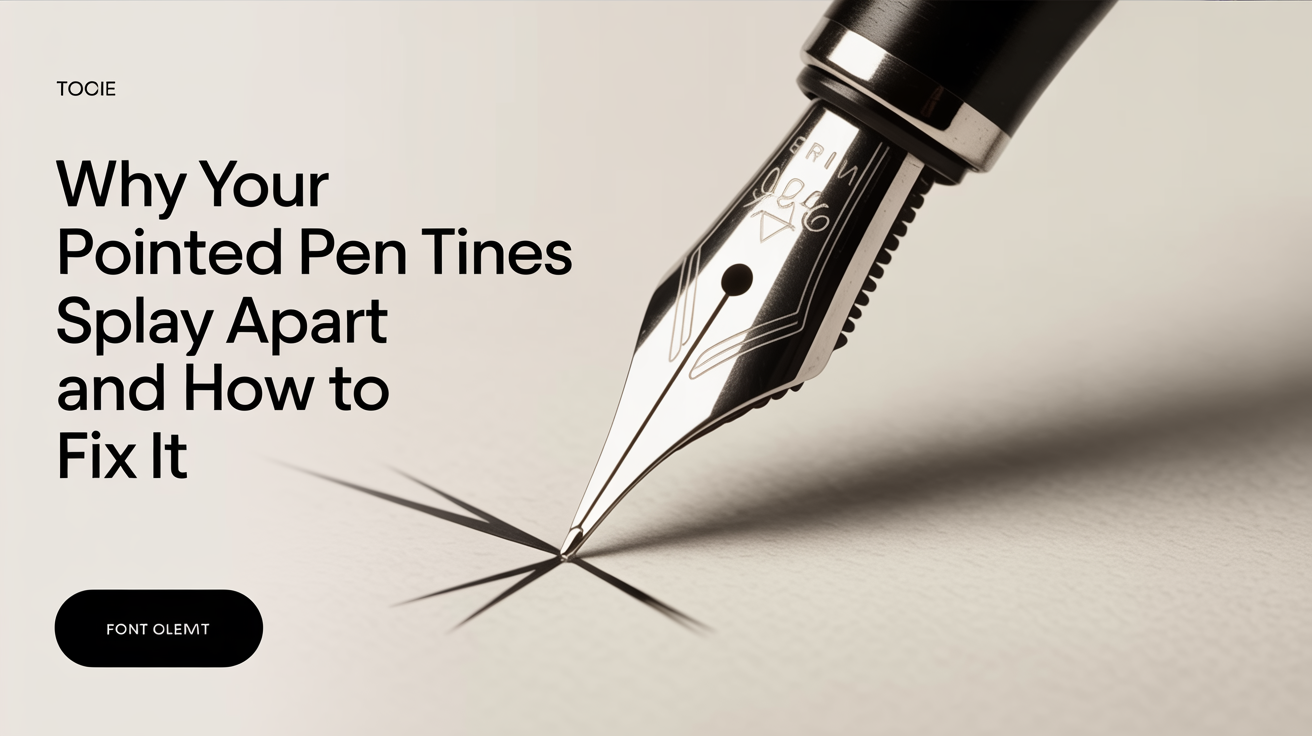
You press into a downstroke, and instead of one clean swelling line, the two tines of your nib peel apart like a tiny wishbone. Sometimes they snap back together for the upstroke. Sometimes they don't, and you're left with a gap running down the middle of your stroke, ink pooling unevenly on either side. This is pointed pen tines splaying, one of the more disheartening problems a beginner runs into, mostly because it feels random. It isn't. There are a handful of specific causes, and once you know which one you're dealing with, the fix is usually straightforward.
What's Actually Happening When Tines Splay
Every pointed pen nib is really two thin metal tines joined at a slit, held together by spring tension in the metal. Press down and that tension flexes outward, the tines separate, and ink flows through the widening gap onto the paper. That's how you get thick downstrokes. Ease off and the tines close back to a hairline for thin upstrokes.
Splaying happens when that mechanism goes further than intended, or fails to reverse. The tines spread wider than the stroke calls for, or stay spread when they should be closing, or the gap between them turns uneven so one tine drags while the other lifts. The result reads as a stroke that looks torn rather than swelled.
A healthy nib still spreads, sometimes visibly, under normal pressure. The problem isn't spreading itself. It's spreading that's excessive, uncontrolled, or that doesn't recover.
The Four Usual Suspects
Before fixing splaying, figure out which of these is causing yours. They often get lumped together, but each has a different fix.
Too Much Pressure for the Nib's Flex Rating
Nibs are made with different amounts of flex, from stiff workhorses to nibs so soft they fan out at the lightest touch. If you're used to a stiffer nib but loaded a softer one, or you're simply new and pressing harder than you realize, the tines spread well past where the letterform needs them to. This is the single most common cause for beginners, since early practice almost always involves too much pressure. For a fuller breakdown of how much force different nibs actually need, this guide to pressure control walks through it stroke by stroke.
A Worn or Damaged Nib
Metal fatigues. A nib flexed thousands of times, dropped, or scraped against a rough paper fiber can develop tines that no longer return to a fully closed hairline. Sometimes one tine bends slightly out of alignment with the other, so they splay unevenly rather than symmetrically. This nib often feels "different" from a fresh one of the same model: less snappy, slower to recover, even under identical pressure.
Wrong Angle Against the Paper
Pointed pen nibs work best with the slit tracking straight down the stroke direction, at a fairly consistent angle to the paper (commonly somewhere around 40 to 55 degrees off horizontal, though this varies by hand and nib). If the nib is rotated so the tines aren't meeting the paper evenly, one tine can catch and drag while the other lifts free, which looks a lot like splaying but is really a contact problem. This is the same misalignment behind catching and skipping, so if you're chasing that too, this piece on nib catching and splattering covers the overlap.
A Nib That's Simply Too Soft for a Heavy Hand
Writers coming from ballpoint or gel pen habits often write with firm, deliberate pressure that doesn't ease up easily. If you consistently reach for very flexible nibs (the kind marketed for dramatic shading) and consistently get splay, the mismatch might not be technique at all. Your natural hand pressure may just call for a firmer nib, at least while you build finer control.
How to Diagnose Which One Is Yours
Work through these in order.
- Test on dry paper with no ink. Press a downstroke motion without ink and watch the tines. If they splay even under light pressure, that points toward a worn or genuinely soft nib, not a pressure habit.
- Compare a fresh nib of the same model. Swap in a brand new nib, same brand and width, and repeat your usual stroke. If it doesn't splay under the same pressure, your old nib is worn or damaged. Retire it.
- Check where the splay happens on the page. Splay that shows up on strokes angled one direction but not others usually means the nib is rotated wrong for your hand, not a pressure issue.
- Watch your upstrokes. If tines close cleanly going up but splay going down, that's ordinary flex, and the question is whether the amount is more than the letterform needs. If tines stay open through the upstroke too, something mechanical is wrong.
- Try a full swap to a stiffer nib. If a firmer nib gives clean strokes under your normal pressure, you've found a flex mismatch rather than a technique fault.
Fixing It: Pressure and Angle Adjustments
If your diagnosis points to pressure or angle, the fix lives in your hand, not your pen case.
Start by practicing pressure in isolation, away from actual letterforms. Draw straight vertical lines, pressing down slowly at the start and easing off slowly at the end, watching the tines rather than the ink. The goal is the minimum pressure that produces the swell you want. Most beginners are surprised how little force that takes.
For angle problems, check paper orientation and wrist position together. Many writers rotate the paper, not the hand, to keep the nib's slit tracking correctly through curves. If you're twisting your wrist mid-stroke to keep the nib flat, the paper probably needs to move instead. Watch the tines as you write a full oval; wherever they lift unevenly is exactly where your angle drifts.
Slow down while you retrain either habit. Splaying caused by pressure or angle tends to fade over a few practice sessions once you're actually watching for it.
When to Just Replace the Nib
Sometimes the honest answer is that the nib is done. Replace it when:
- A fresh nib of the same model, tested under your normal pressure, doesn't splay the way your current one does.
- The tines look visibly uneven or bent when you inspect the nib closely (a loupe or strong reading glasses help here).
- The nib has been dropped, or has caught hard on paper and bent, even once.
- You've corrected pressure and angle and the splay persists anyway.
Nibs are inexpensive relative to the frustration of fighting a damaged one, and there's no shame in retiring one after heavy use.
Splaying vs. Railroading vs. Ink Starvation
These three get confused constantly because they all show up as a broken or doubled line down a downstroke, but the causes and fixes differ.
| Problem | What it looks like | Root cause | Fix |
|---|---|---|---|
| Tine splaying | Tines visibly spread wider than intended, or don't close on the upstroke | Too much pressure, worn nib, wrong angle, or nib too soft for the hand | Adjust pressure or angle, or replace the nib |
| Railroading | Two parallel ink lines with a dry gap between them, tines may look normal | Ink not flowing fast enough to fill the widened gap, often from too much speed or a nib not primed | Slow the downstroke, prime the nib properly, check ink flow |
| Ink starvation | Faint, scratchy, or skipping line, sometimes total dryness | Not enough ink loaded, or a nib with surface tension that resists new ink | Reload more often, prepare the nib so ink adheres |
The quickest way to tell them apart: railroading and ink starvation are ink flow problems where the tines are doing what they should. Splaying is a tine behavior problem, visible even before ink enters the picture. Still fighting a doubled line after ruling out splay? This guide to fixing railroading is the next stop. And if a brand new nib feels scratchy or refuses ink from the first stroke, that's usually an unprepared nib, covered in this piece on why ink won't stick to a new nib.
Frequently Asked Questions
Is some tine splaying normal, or should the tines never separate?
Some separation is completely normal and is exactly how a pointed pen produces thick downstrokes. The problem isn't separation itself, it's separation that's excessive for the letterform, uneven between the two tines, or that fails to close back up on the upstroke.
Can I bend the tines back myself if they've splayed permanently?
Very gently, sometimes. Some writers use fine tweezers to nudge a slightly bent tine back into alignment, but it's delicate work on thin metal and easy to make worse. For an inexpensive nib, replacing it is usually faster and safer.
Does nib size affect how easily tines splay?
Yes. Smaller, finer nibs generally have less metal in the tines and can be more prone to splay under heavy pressure than broader, sturdier nibs, though this varies a lot by brand and design. If you're new and pressing hard, a slightly stiffer or larger nib can be more forgiving while you build control.
Why does my nib splay only on certain letters?
Letters with sharp direction changes, tight curves, or long unsupported downstrokes (like capital flourishes) put more demand on angle consistency than simple straight strokes. If splay only shows up there, angle drift through the curve is more likely than a pressure or flex problem.
Should I switch to a stiffer nib permanently, or keep working on pressure control?
Depends on your goals. A stiffer nib is a reasonable long-term choice if you mainly want clean, consistent lines without much shading. If you want the dramatic thick-thin contrast flexible nibs produce, keep building pressure control instead of avoiding them, since that control carries over to every nib you pick up afterward.