Projects
How to Make a Hand-Lettered Gift Tag
Learn how to letter a gift tag from scratch. Covers paper, ink, layout planning, punching, ribbon, and tips for keeping strokes crisp at a small scale.
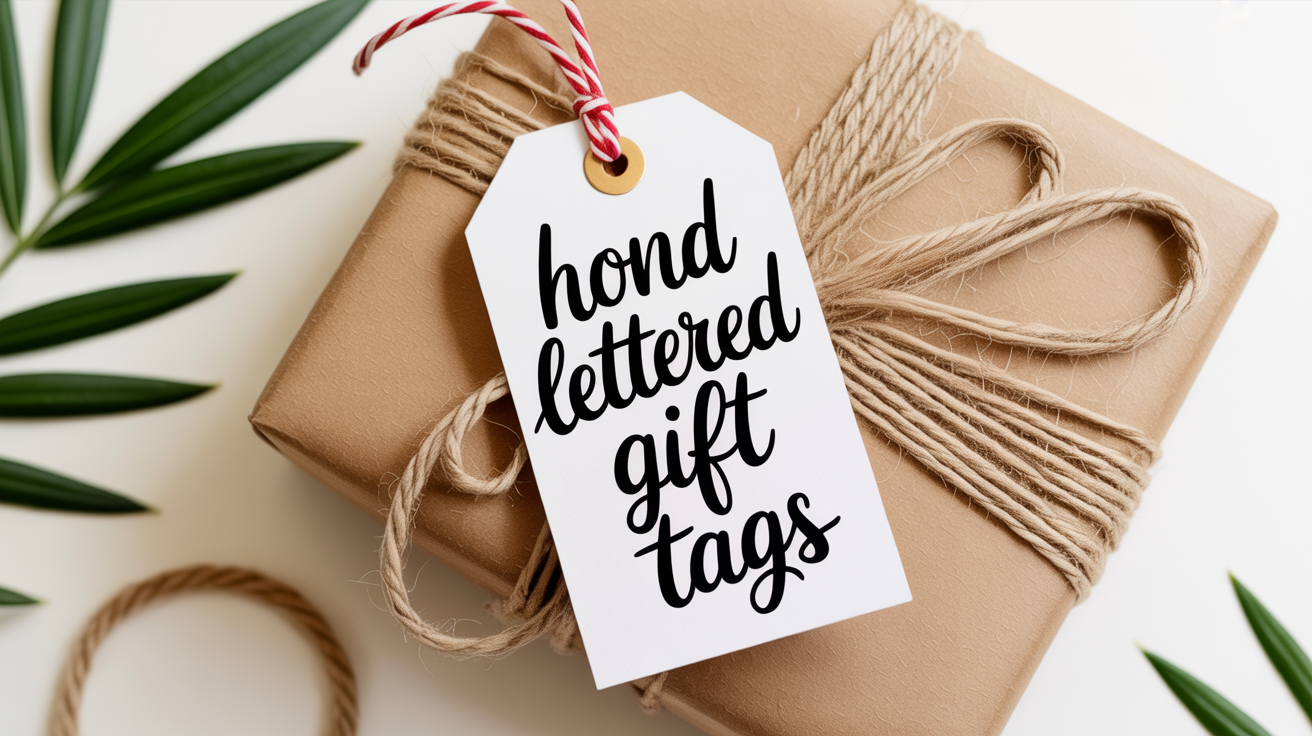
A hand-lettered gift tag takes about ten minutes to make and adds something no printed sticker can match: the person receiving it knows you touched it. This guide walks you through the whole process, from choosing your blank to threading the ribbon, so your first batch comes out looking intentional rather than accidental.
Choosing Your Blank and Surface
You have two options: cut your own tags from card stock, or buy pre-cut blanks and letter directly on them.
Pre-cut blanks are the easier starting point. Craft stores and online sellers carry kraft paper blanks, white card stock tags, and smooth manila tags in packs of fifty or more. Look for a weight between 65 lb and 110 lb (roughly 175 to 300 gsm). Thinner stock buckles when wet ink hits it; heavier card stock holds its shape.
Kraft paper has a warm, textured surface that looks great but absorbs ink faster than smooth card stock. If you are using a brush pen on kraft, press lightly and move at a steady pace. Dragging too slowly causes the ink to feather along the paper fibers. A white or gold ink pen on dark kraft reads clearly and feels intentional; pigment-based markers tend to stay crisp on that surface better than dye-based inks.
Smooth white card stock gives beginners the most control. Ink beads on the surface for a moment before drying, which gives you slightly sharper edges. It also erases cleanly with a pencil eraser after you remove your guidelines.
If you want to practice the layout before committing to a real blank, cut a few practice tags from cheap copy paper at the same dimensions. The pen behavior will differ slightly, but the spacing practice is genuine.
Paper and Ink Choices at a Small Scale
Gift tags are small, which means your tools matter more than on a large format. A brush pen that writes beautifully on a greeting card can feel awkward when your writing space is only 2 inches wide.
Fine-tip brush pens (also called small-tip or extra-fine) are the most practical choice for tags. The tip is short and stiff enough to control at reduced sizes while still producing a thin upstroke and a thicker downstroke when you vary pressure. For a complete look at the brush pen options available to beginners, see The Best Brush Pens for Beginners.
Pointed pen and dip ink works well on smooth white card stock. The fine nib naturally produces delicate hairlines, which suit a small tag format. Avoid dip pen on uncoated kraft because the nib catches on the fibers. If you want to use a dip pen on kraft, seal the surface first with a light coat of gum sandarac powder (rub it in with your fingertip, brush off the excess) to reduce feathering.
Ink color: Black reads well on white and natural kraft. Sepia gives a vintage look on kraft. For holiday tags, a deep forest green or a matte gold pigment ink (applied with a brush pen or ruling pen) reads clearly from across a table.
Keep a piece of scrap paper nearby and do a few strokes before touching the tag. This primes the pen and shows you how the ink is behaving on a similar surface.
Planning Your Layout
Small formats reward simple layouts. Trying to fit a long phrase onto a 2 x 3.5-inch tag usually ends in cramped, hard-to-read letters. Here is how to plan before you write.
Start with the name or phrase. For a gift tag, the most common text is a name ("For Emma"), a short sentiment ("With love"), or a seasonal label ("Happy Birthday"). If you are lettering a name in script, count the letters. A long name like "Christopher" takes more horizontal space than "Jo."
Rough it out on scrap. Write the phrase at roughly the size you plan to use on the tag. Measure the width. Compare that width to the tag. If it does not fit comfortably with a small margin on each side, either reduce your letter size, abbreviate, or switch to a stacked layout (name on one line, phrase on another).
Draw a light pencil baseline. Even experienced letterers use a baseline on small formats. A single light pencil line keeps your word from drifting uphill or downhill. If you want consistent letter height, add a cap-height line above it. Erase both after the ink dries completely.
Center vs. left-align. Centering looks polished but requires counting letter widths in advance or pre-writing the phrase, measuring it, and placing it so equal space falls on each side. Left-aligned layouts are faster to execute and still look clean, especially when the tag has a decorative punch hole at the top that draws the eye.
For a deeper look at layout decisions and spacing, How to Letter a Quote: Layout and Composition covers the same principles at any scale.
Punching the Hole and Adding Ribbon
The hole punch step comes before the lettering if you are using a hand punch, because pressing down on the tag can leave dents near the punch site. If you have a sturdy craft punch that does not flex the card, you can punch after lettering, but before the ribbon goes on.
Punch placement. Most standard gift tags have the hole centered at the short top edge, about 3/8 inch from the top. If you are cutting your own tags, position the hole so there is at least 1/4 inch of card above it to prevent tearing when the ribbon pulls.
Ribbon or twine choices. Thin satin ribbon (1/8 inch wide) threads easily through a standard hole punch opening and ties into a neat bow. Baker's twine has a handmade quality that suits kraft tags well. Jute cord is sturdy but harder to tie tightly in cold weather. Cut your ribbon or twine at about 10 to 12 inches. That length leaves enough to tie a bow with two loops and two short tails.
Sealing the tag (optional). A light spray of fixative or matte varnish after the ink dries fully protects the lettering from smudging if the tag gets handled a lot. Hold the can at least 12 inches away and do a thin coat. One pass is enough.
Writing Small Without Losing Stroke Contrast
The biggest struggle beginners have on gift tags is that thick-thin contrast disappears at small sizes. Here are the adjustments that help.
Slow down on downstrokes. Thin upstrokes happen fast; thick downstrokes require a moment of deliberate pressure. At small scales, your natural tendency is to rush, which flattens the contrast. Move through the downstroke steadily rather than quickly.
Reduce your letter height rather than your pen size. If letters feel crowded, shrink your x-height (the height of a lowercase letter body) instead of switching to a finer tool. A shorter but correctly formed letter reads better than a taller letter where the strokes blur together.
Practice on the practice tag first. Write the actual phrase on a scrap tag at the same size. Look at it from a foot away. If the letters read clearly, you are ready to do it on the real blank.
If your letters look awkward rather than calligraphic, Faux Calligraphy: How to Fake It with Any Pen shows a method that reliably produces thick-thin contrast even with a standard ballpoint, which can save a batch of tags when a pen is misbehaving.
Seasonal Variations
The same tag-making process works across occasions with small adjustments to color, phrase, and embellishment.
Birthdays. A bold single word like "Celebrate" or the recipient's name in a larger script reads well. Consider a pop of color: a bright coral or a deep teal on white card stock.
Winter holidays. "Joy," "Peace," and short seasonal phrases are classic. Deep green or burgundy on kraft feels traditional. Gold ink on black card stock is striking if you can find black pre-cut tags or cut your own.
Thank-you tags. "Thank you" stacked in two lines, "You" in larger script below "Thank," is a layout that fits neatly on a standard tag. Stick to one or two colors at most.
Everyday gifts. A simple first name on a clean white tag with thin black lettering is quiet but effective. No flourishes needed.
For more project ideas that build on the same skills, Hand-Lettered Greeting Cards for Beginners uses the same layout thinking at a larger scale.
Frequently Asked Questions
Can I use a regular pen for hand-lettered gift tags? Yes. A faux calligraphy approach lets you add thick-thin contrast to any pen after the fact by thickening the downstrokes with a second pass. The result reads as calligraphic even though the tool is a standard pen. This is a useful backup when your brush pen runs dry mid-project.
What size should a gift tag be? A common size is 2 x 3.5 inches, which is roughly the size of a business card. Oval or rounded-rectangle tags at similar dimensions also work well. Anything smaller than 1.5 inches wide makes lettering more difficult for beginners.
How do I stop my ink from smearing on kraft paper? Give the ink more drying time than you think it needs, especially with brush pens. Dye-based inks dry faster than pigment inks. If smearing is a recurring problem, try a pigment-based pen or switch to a smooth-coated kraft blank rather than raw kraft.
Do I need to seal the finished tag? Not always. Tags handled briefly during gift wrapping are fine without sealant. If the gift will travel in a bag or be handled repeatedly before opening, a thin layer of matte fixative spray protects the lettering without changing the look.
Can I make tags in advance and store them? Yes. Store finished, unsealed tags flat in a folder or between sheets of parchment paper so they do not scratch each other. Sealed tags can be stacked more loosely. Keep them out of direct sunlight, which fades dye-based inks over time.